Multiscale Observations
Molecular differentiation across cosmic scales, from extragalactic environments and local star-forming regions to protoplanetary disks and planetary atmospheres.
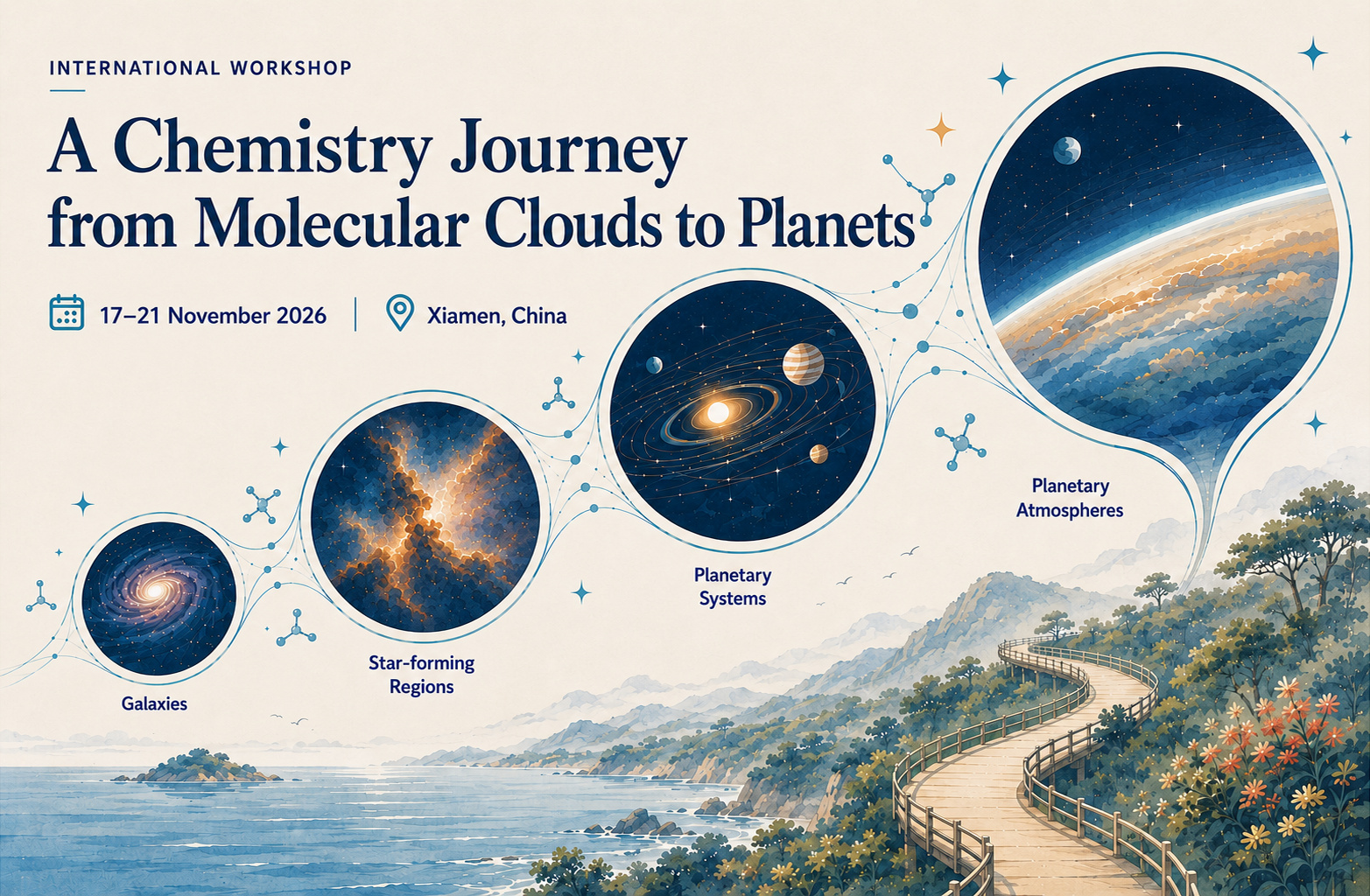
Chemistry is the fundamental thread linking the diffuse interstellar medium to the complex architectures of planetary systems.
Deciphering the transition from simple atomic gas to the prebiotic complexity observed in star-forming regions and protoplanetary disks requires a multiscale perspective, integrating extragalactic environments, nearby molecular clouds, and microscopic chemical processes occurring on grain surfaces.
Recent breakthroughs enabled by facilities such as ALMA and JWST, together with rapid advances in laboratory astrochemistry, molecular spectroscopy, and physical–chemical modeling, have transformed our understanding of the chemical Universe. At the same time, these developments have highlighted the growing need for closer collaboration between observers, experimentalists, spectroscopists, and theorists.
This workshop will bring together researchers working across these complementary disciplines to discuss recent advances in astrochemistry from molecular clouds to planetary systems and potentially habitable worlds. Through invited reviews, contributed talks, poster presentations, and dedicated discussion sessions, the meeting aims to foster interdisciplinary collaborations and identify key scientific challenges for the next generation of astronomical facilities and laboratory studies.
Participants
Discussions
Scientific Exchange
Collaboration
Molecular differentiation across cosmic scales, from extragalactic environments and local star-forming regions to protoplanetary disks and planetary atmospheres.
The chemical and physical evolution of gas and dust from diffuse interstellar clouds to dense molecular cores.
Identification and characterization of new spectral features, with emphasis on complex organic molecules and isotopologues.
Experimental studies of gas-phase reactions and solid-surface processes under interstellar conditions.
Synergies among gas-phase, grain-surface, and ice-mantle models to interpret abundances and predict chemical evolution.
Dedicated sessions connecting observers, experimentalists, spectroscopists, and theorists.
The workshop emphasizes in-depth scientific exchange rather than a large number of presentations, with a program designed to maximize interaction across different areas of astrochemistry.
Contributed Talks & Posters. Participants wishing to present are invited to submit a title, preferred presentation type (talk or poster), and a short abstract (≤250 words) through the registration form. Contributed talks will be selected by the Scientific Organizing Committee.
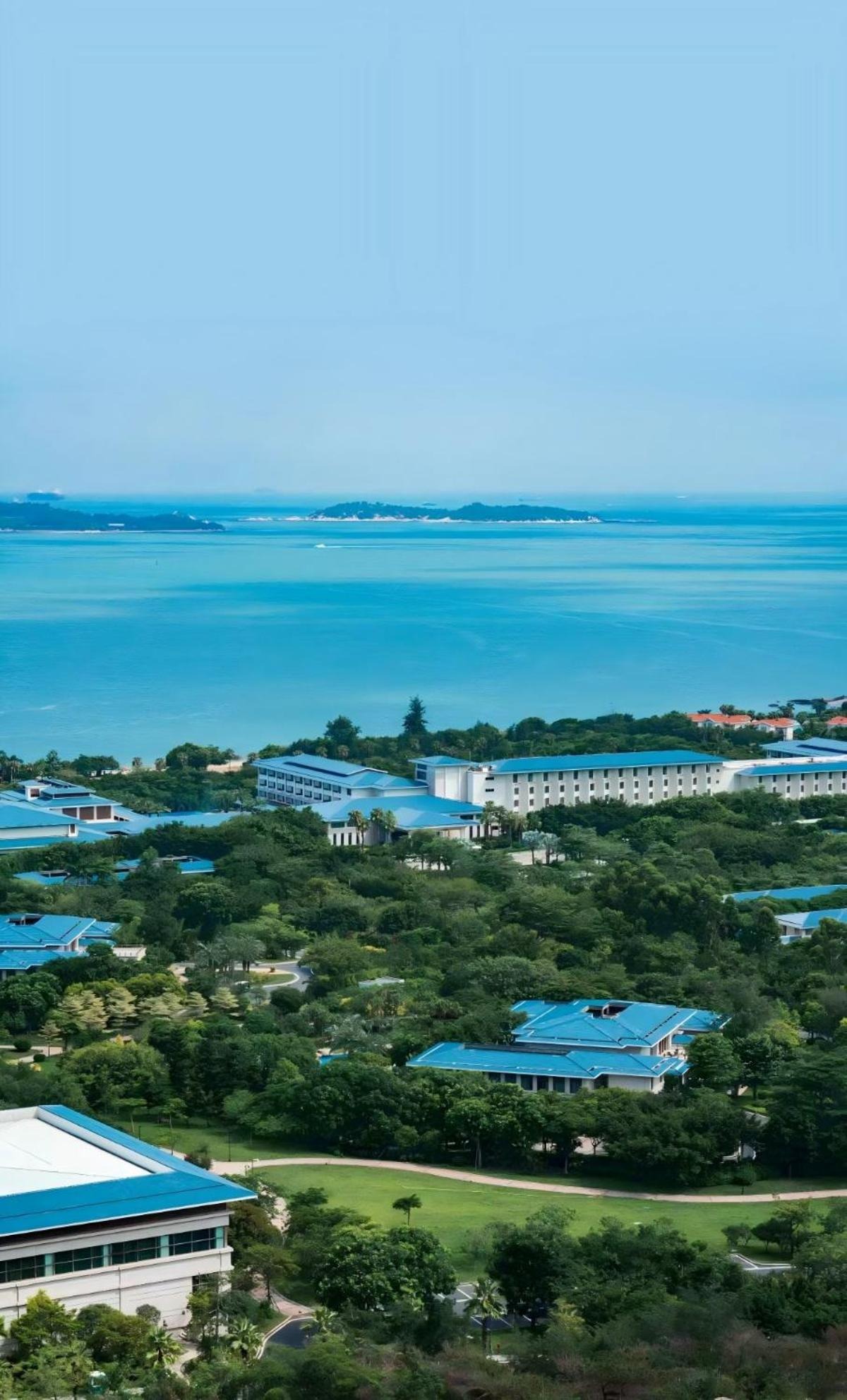
厦门海悦山庄酒店
Set between the sea and the hills of Xiamen, the Seaview Resort provides an inspiring setting for scientific exchange, with the conference venue, accommodation, and dining all conveniently located on one campus.
Participants will enjoy a relaxed environment that encourages discussions beyond the lecture hall, from coffee breaks and meals to evening conversations overlooking the coastline. The integrated venue offers excellent opportunities for researchers across career stages to build new collaborations and exchange ideas throughout the workshop.
View location on map ↗Hotel reservations can be requested through the online registration form and will be allocated subject to availability.
Registration is open to faculty members and postdoctoral researchers. Applications from outstanding senior PhD students working in astrochemistry and related fields are also welcome.
Online Registration Form
Google Forms OR WPS FormsRegistration fees will be collected onsite during 17–20 November 2026. Payment may be made by bank transfer or credit card.
Please indicate your visa requirements, financial support requests, and travel itinerary in the registration form to help us prepare the necessary arrangements.
Participants requiring a visa to enter China should indicate this in the registration form and specify the travel dates to be covered by the invitation letter.
The Local Organizing Committee will provide an official invitation letter to support the visa application.
Limited financial support is available and may cover the registration fee, accommodation, or both.
Priority will be given to selected contributed speakers, early-career researchers, participants travelling long distances, and those with limited institutional support.
Seaview Resort Xiamen is conveniently located approximately 20 minutes from Xiamen Gaoqi International Airport and Xiamen Railway Station.
Participants' travel itineraries will be collected during registration. Airport transfers may be arranged where feasible, and detailed arrival information will be provided prior to the workshop.
Siyi Feng (XMU) · Nami Sakai (RIKEN) · Donghui Quan (XJTLU) · Sheng-yuan Liu (ASIAA) · Paola Caselli (MPE) · Izaskun Jiménez-Serra (CAB) · Valentine Wakelam (CNRS) · Ankan Das (IASES) · Silvia Spezzano (MPE) · Eleonora Bianchi (INAF)
Siyi Feng (Chair) · Lehan Gao · Qiancheng Yang · Jinye Xie · Dan Miao · Botao Jiang
CODE OF CONDUCT:
The workshop is committed to providing a welcoming, inclusive, and respectful environment for all participants, regardless of career stage, nationality, gender, ethnicity, religion, disability, sexual orientation, or other personal characteristics.
Participants are expected to treat others with courtesy and professionalism, foster open and constructive discussion, respect differing viewpoints, and support collaboration and the free exchange of ideas.
Harassment, discrimination, intimidation, and inappropriate behavior will not be tolerated. Concerns may be reported confidentially to any member of the Local Organizing Committee.